Millions of documents
A question as simple as “which services are failing?” touches millions of log lines and spans.
How customers use Coralogix from the terminal and from coding agents, through the Coralogix CLI and the Coralogix MCP server. Every figure is live.
The coding agents people use to drive Coralogix from the CLI.
What people do once they work headlessly: what they ask Coralogix for, and what they build.
Learn more: The Coralogix CLI
Agents use Coralogix differently from people. They ask more questions, read every answer into a limited context window, and come back to the same data again and again. Five things make that work.
An agent that pulls raw logs into its context fills it within a few thousand lines, and pays in tokens for every one. Coralogix turns that around: a DataPrime query filters, groups and aggregates millions of documents where they live, and sends back only the rows that answer the question.
The agent asks which services are failing and gets a ranked list, not a log dump. Its context window stays free for reasoning.
A question as simple as “which services are failing?” touches millions of log lines and spans.
DataPrime filters, groups and aggregates them in the customer’s own storage, in seconds.
The agent reads the handful of rows that answer the question, not the million that don’t.
Installing the Coralogix CLI adds more than 20 skills to a coding agent: short, tested guides for querying logs, spans and metrics, writing DataPrime, building dashboards, defining alerts and SLOs, following a RUM session and cutting costs.
The agent loads the skill it needs when it needs it. Instead of guessing at syntax it explores: it finds the right fields, runs the right query and follows the answer to the next question.
The Coralogix CLI writes its answers in three formats: text for people at a terminal, JSON for scripts, and TOON for agents. One flag, -o toon, or a profile default, and every answer comes back sized for a context window.
TOON, Token-Oriented Object Notation, states each field name once and then lists the values row by row, where JSON repeats every key on every row. The data is identical; the agent reads a fraction of it. The more rows an answer has, the bigger the saving.
[{"service":"checkout","errors":412,"p95_ms":830}, {"service":"payments","errors":96,"p95_ms":410}, {"service":"search","errors":12,"p95_ms":220}, {"service":"auth","errors":3,"p95_ms":95}, {"service":"inventory","errors":0,"p95_ms":180}]
services[5]{service,errors,p95_ms}: checkout,412,830 payments,96,410 search,12,220 auth,3,95 inventory,0,180
Agents ask follow-up questions, and the follow-up is often about last month rather than the last hour. Where older data sits in cold storage, that means a rehydration job first: restore the data, wait, then query.
Coralogix gives you unlimited access to your data, queried directly in your own cloud object storage. There is no restore step and no second hot copy to pay for, so an agent gets an answer about last quarter as readily as one about the last five minutes.
Agents are curious. A single investigation can run dozens of queries, and a team of agents runs thousands a day.
Coralogix does not charge per query or per byte scanned, so nobody has to ration an agent’s curiosity, or decide in advance which questions are worth the bill.
Server-side aggregation, querying in place and flat pricing all come from the same design: Streama, and the telemetry lake beneath it. Walk through the model that handles billions of daily queries across hundreds of petabytes.
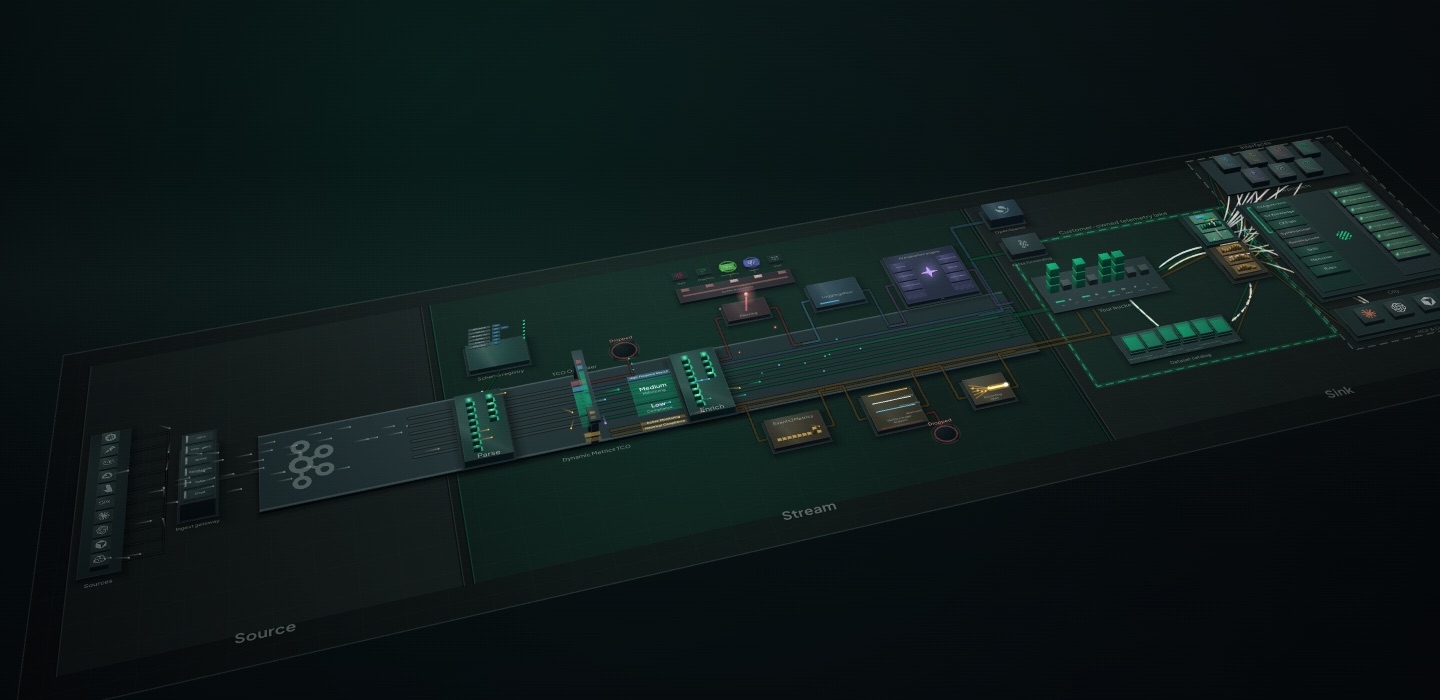 Take the Streama Tour